
SNORKLE Study
Mixed-methods qualitative research study
Data collection in progress
SNORKLE: SCN2A Narratives, Outcomes, Research, Knowledge & Lived Experience
The SNORKLE Study is designed to inform Patient-Focused Drug Development efforts. The research aims to learn directly from families what is most important to them for future treatments.
Study PI: Dr. Christina SanInocencio
Research Team
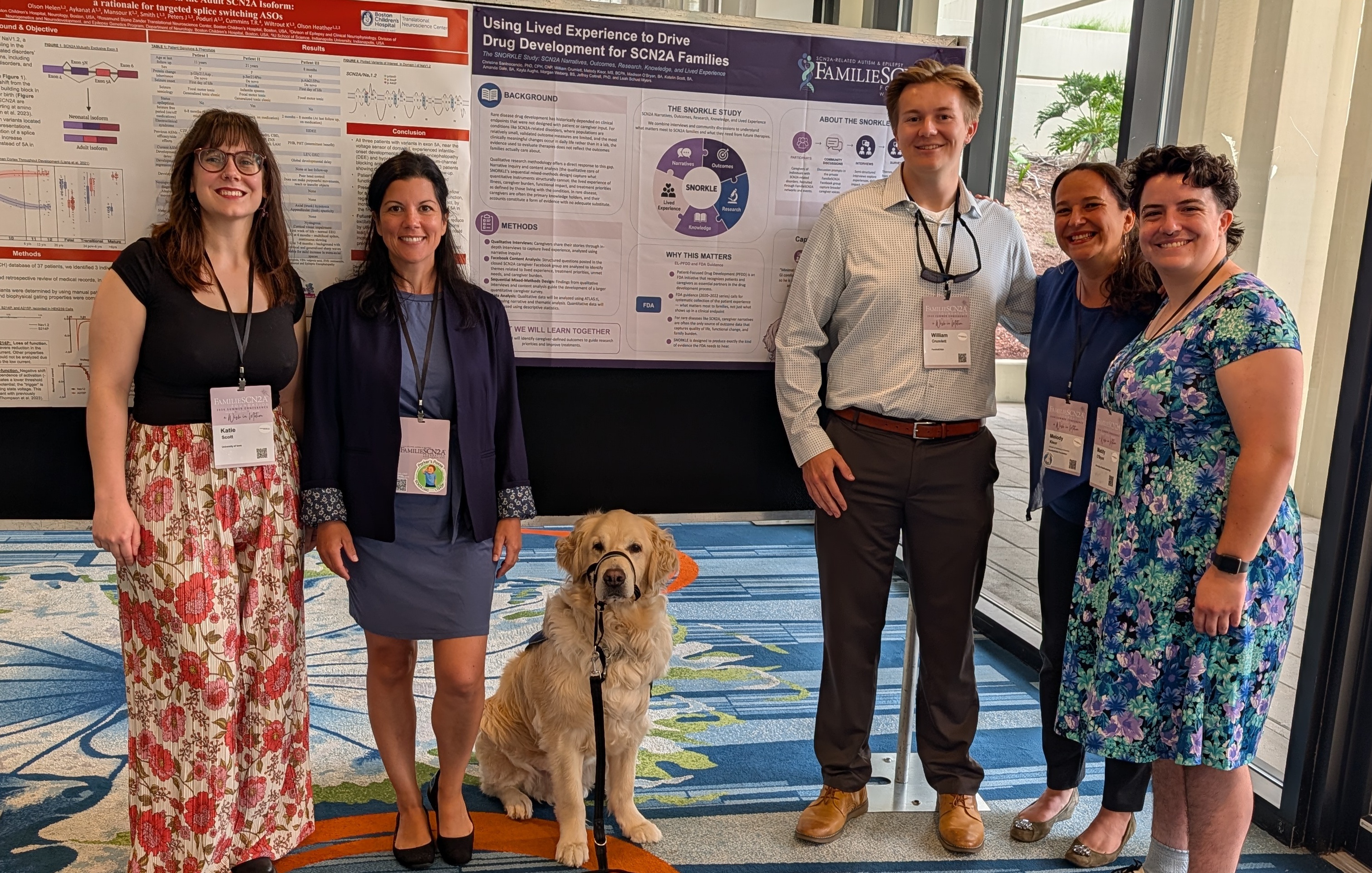
(L to R)
Katelin Scott, PhD candidate - University of Iowa
Christina SanInocencio, PhD - Study PI - FamilieSCN2A TASCO
Snorkel the service dog
William Crumlett - Notre Dame Patient Advocacy
Melody Kisor, MS, BCPA - FamilieSCN2A Director of Advocacy & Education
Madison O'Bryan - University of Iowa
Posters
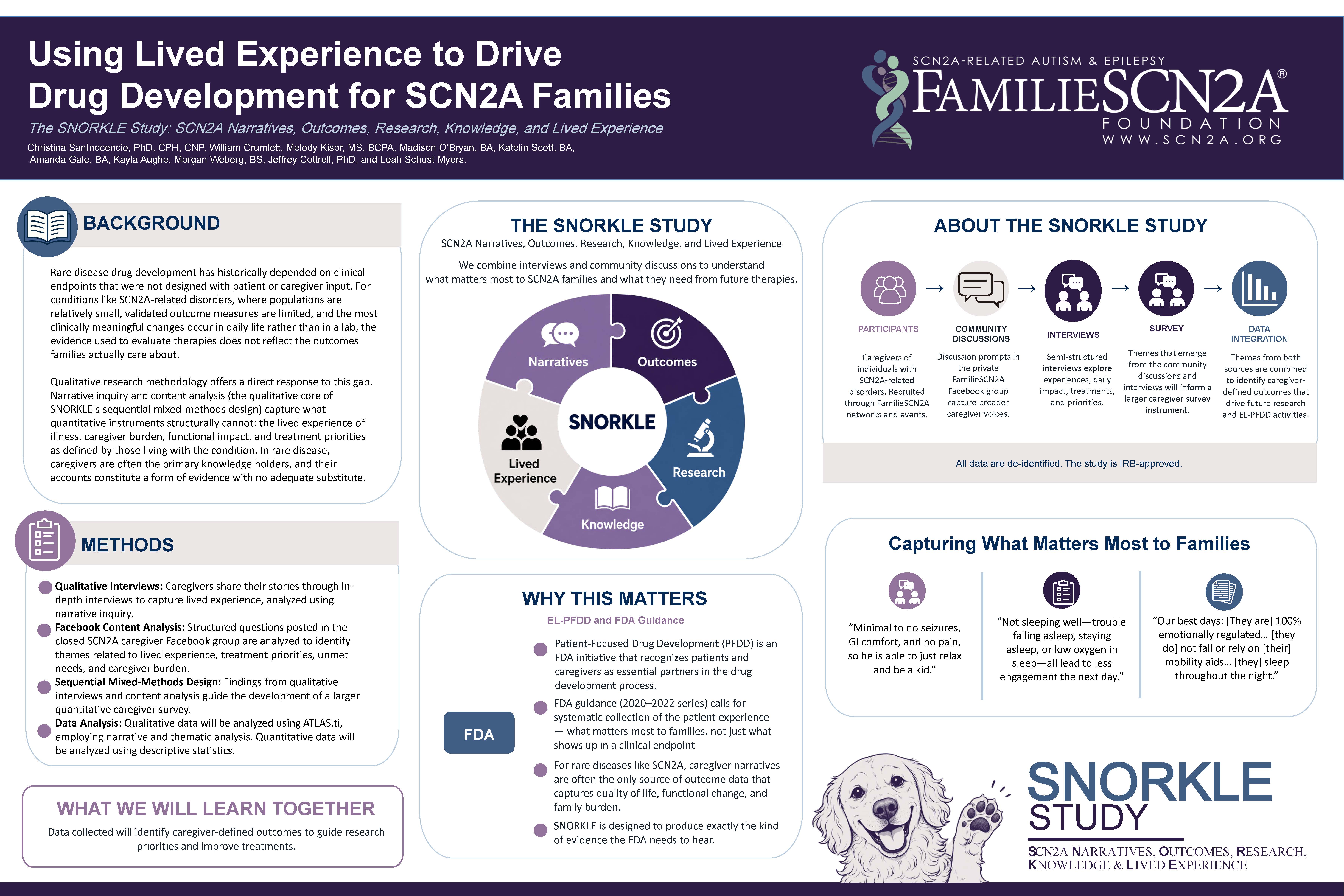
Using Lived Experience to Drive Drug Development for SCN2A Families: The SNORKLE Study - SCN2A Narratives, Outcomes, Research, Knowledge, and Lived Experience
Christina SanInocencio, PhD, CPH, CNP, William Crumlett, Melody Kisor, MS, BCPA, Amanda Gale, BA, Kayla Aughe, Madison O’Bryan, BA, Morgan Weberg, BS, Jeffrey Cottrell, PhD, and Leah Schust Myers. FamilieSCN2A Foundation - Gettysburg, PA, USA
Purpose: The SNORKLE Study (SCN2A Narratives, Outcomes, Research, Knowledge, and Lived Experience) is a mixed-methods study led by the FamilieSCN2A Foundation. The goal of the study is to better understand how families experience SCN2A-related disorders and use that information to support future research, outcome-measure development, and drug development.
Background: Rare disease drug development has often relied on clinical endpoints that were created without meaningful input from patients or caregivers. This is especially challenging for SCN2A-related disorders, where the patient population is relatively small, validated outcome measures are limited, and many of the changes that matter most to families happen in daily life rather than in a clinic. As a result, traditional measures may not fully capture changes in function, quality of life, caregiver burden, or the outcomes families consider most important.
Methods: SNORKLE employs a sequential mixed methods design integrating qualitative and quantitative inquiry.
Data Collection: Qualitative data were gathered through two sequential mechanisms. First, weekly insight questions were administered within a closed SCN2A caregiver Facebook group, with caregiver responses aggregating in threaded discussions. This asynchronous approach facilitates naturalistic data collection within an existing online community. Second, purposively sampled caregivers participated in semi-structured interviews, enabling in-depth exploration of lived experiences and contextual factors. Qualitative findings from both phases subsequently informed the development of a larger caregiver survey instrument.
Data Analysis: Facebook responses underwent qualitative content analysis to systematically identify thematic patterns regarding daily life experiences, unmet clinical and psychosocial needs, treatment priorities, and caregiver burden. Interview data were analyzed using narrative inquiry methodology, which interrogates not merely what occurred but how families construct meaning and interpret their experiences within broader contexts. This dual analytical approach enabled triangulation across data sources.
Ethical considerations: The study received Institutional Review Board approval and implemented an opt-out consent procedure for asynchronous Facebook data. All analyses utilized de-identified data to ensure confidentiality protections for participants and their families.
Results: To date (August, 2026), 234 caregiver responses have been collected across seven structured questions posted in the Facebook group. Although analysis and data collection is ongoing, initial analysis finds that families define meaningful outcomes as extending beyond seizure control to include emotional regulation, communication, independence, social connection, and participation in everyday life. Following caregiver interviews launched at the 2026 SCN2A Family & Professional Conference, Facebook responses and interview transcripts will be analyzed using narrative analysis and inductive thematic analysis.
Conclusion: This approach supports the goals of Patient-Focused Drug Development (PFDD), which recognizes that patients and caregivers should play an active role in identifying the outcomes that matter most when treatments are developed and evaluated. Findings will also contribute to an Externally-led Patient-Focused Drug Development (EL-PFDD) meeting with the FDA, and shape the “Voice of the Patient Report” that follows.
Through SNORKLE, we hope to make sure that the experiences and priorities of SCN2A families are included throughout the drug-development process. By collecting caregiver stories in a systematic way, this study will help define meaningful outcomes based on the changes families see and value in everyday life.
Part of the Patient-Centered Drug Development advocacy plan
Patient-Centered Drug Development is an intentional effort to ensure that patient needs and priorities are meaningfully included at all stages of clinical research and development. Regulatory and industry partners play critical roles in the treatment development process. Learn how FamilieSCN2A engages in patient-centered drug development by amplifying the patient voice with regulatory agencies and collaborating with industry partners.